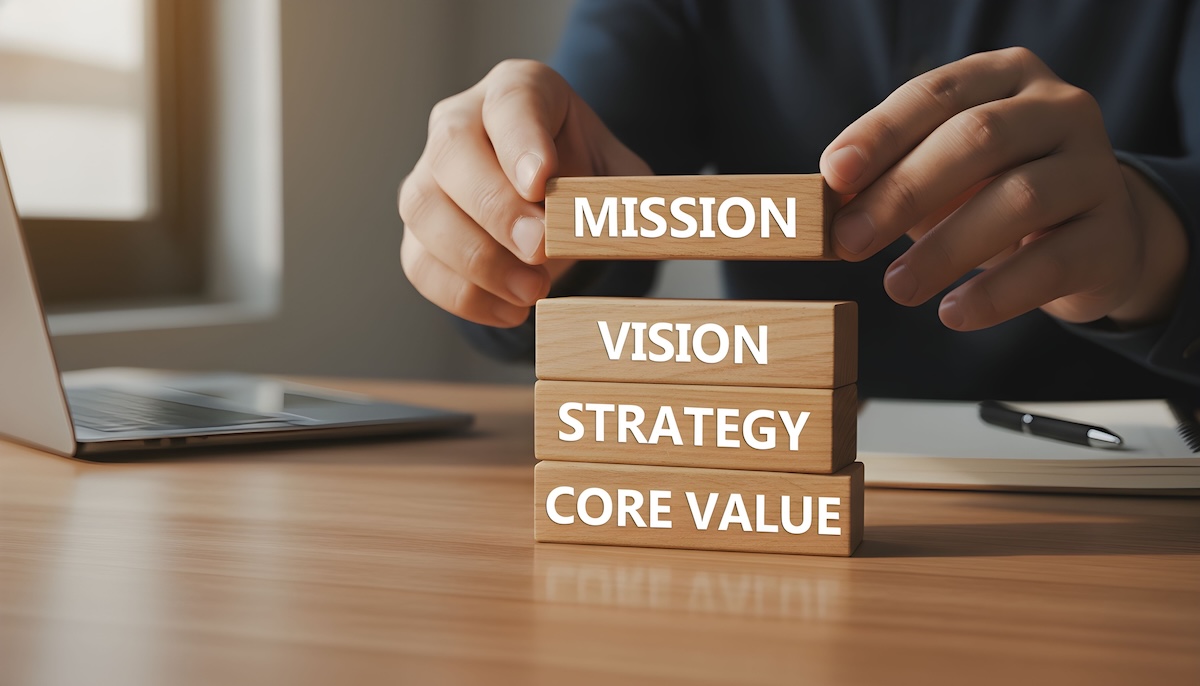
Almost every SME has a vision and a mission statement. Very few actually run their business by them.
They get written during strategy days, rebrands, or moments of frustration. They sound ambitious and thoughtful. They look good on walls, websites, and pitch decks. They are occasionally referenced during onboarding or quarterly meetings. Then the business returns to day-to-day reality, and those statements quietly disappear.
Decisions are made based on urgency rather than direction. Priorities change depending on which problem is loudest. Teams focus on what gets chased, not what is written down. Over time, leaders stop referencing the vision and mission altogether because they no longer feel useful.
When this happens, many founders conclude that vision and mission are “nice to have” but impractical. They assume execution is driven by targets, pressure, and personality, not by purpose or direction. In reality, the failure is not the concept of vision and mission. It is how they are designed and how they are used.
High-performing SMEs treat vision and mission very differently. They do not treat them as inspirational statements or branding assets. They treat them as operating tools. When done properly, vision and mission reduce decision friction, align teams, and create consistency in execution without constant leadership intervention.
This article explains how to craft a vision and mission that actually drive action, using a systems-based approach aligned with GTi’s GrowthOps framework for strategic clarity and execution.
💡 Key Insight: A vision and mission that do not actively shape decisions, priorities, and behaviour are not strategic tools - they are decoration.
Why most vision and mission statements fail in SMEs
Most vision and mission statements fail for a simple reason: they are created as communication artefacts, not as decision-making frameworks.
They are often written in isolation from how the business actually operates. The language is designed to sound inspiring rather than to be used. Aspiration replaces function. Emotion replaces clarity.
Once written, these statements are rarely connected to planning, budgeting, hiring, performance management, or weekly execution. They sit alongside the business rather than inside it.
Teams are not confused about what really matters. They quickly learn by observing behaviour. They pay attention to what leaders review, what gets rewarded, and what is ignored. If vision and mission are not visible in those mechanisms, they are treated as optional.
That creates a quiet but dangerous gap. Leaders believe they have provided direction. Teams experience constant change and mixed signals. Accountability weakens because there is no stable reference point for decision-making.
The result is predictable: more escalations, more rework, more “alignment meetings”, and more founder involvement to keep things moving.
If your vision and mission are not changing choices, they are not doing the job.
❌ Common Mistake: Treating vision and mission as branding exercises instead of decision-making frameworks.
The real role of vision and mission in a growing business
Vision and mission are often used interchangeably, which weakens both.
Vision answers: where are we deliberately going?
Mission answers: why does this business exist, who does it exist for, and how do we choose to operate while getting there?
📖 Definition: Vision describes the future state the business is deliberately building. Mission defines the purpose and principles that guide decisions on the journey.
Together, they provide context for strategy and execution. They reduce ambiguity. They allow people to make aligned decisions without escalating everything to leadership.
Without a clear vision, strategy becomes scattered. Without a clear mission, behaviour becomes inconsistent. Without both, leadership becomes reactive.
In a growing SME, vision and mission are not abstract ideas. They are stabilising forces. They give teams a reference point when priorities compete and pressure increases. They make the business more coherent, which makes execution easier and more predictable.
That coherence is the real value.
Vision vs strategy vs goals (and why confusing them breaks execution)
A huge reason vision and mission fail is that they get mixed up with strategy and goals.
Vision is not a plan. Strategy is not a wish. Goals are not direction.
Here is the clean separation:
Vision defines the long-term future state the business is intentionally building. It is directional rather than tactical.
Strategy defines the choices the business makes to move toward that vision. It is about focus and trade-offs.
Goals define measurable outcomes along the chosen path. They are time-bound and specific.
Mission defines why you exist and how you behave while pursuing the vision and executing the strategy.
When vision is vague, strategy becomes reactive. When strategy is unclear, goals multiply. When goals multiply, focus disappears.
Clear vision simplifies strategy. Clear strategy limits goals. Limited goals improve execution.
If your business feels scattered, this is usually the sequence: unclear vision - unfocused strategy - too many goals - constant priority switching - poor execution - founder intervention.
Vision and mission are not the only fix, but they are the foundation for clarity.
Why vision must be operational, not inspirational
Inspiration without application creates cynicism.
Teams hear bold statements about purpose and direction, then watch leaders behave in contradictory ways. The gap becomes obvious. Over time, people stop taking the vision seriously because it has no bearing on how decisions are actually made.
⚠ Warning: A vision that is not reinforced through decisions and trade-offs becomes background noise, not direction.
An operational vision shows up in trade-offs. It influences which opportunities are pursued and which are declined. It shapes how resources are allocated. It provides a reason to say no.
If a vision does not change behaviour, it is not functioning.
A strong test is this: if you removed your vision statement from the business tomorrow, would anything change? Would any decision be different? Would any priority shift? Would any client be declined?
If the honest answer is “no”, then you do not have an operational vision. You have a poster.
The GrowthOps approach to vision and mission
At GTi, vision and mission are designed inside GrowthOps because they sit at the top of the operating system.
They are not standalone statements. They are inputs into how the business plans, prioritises, and executes.
A practical GrowthOps approach connects vision and mission to:
Strategic filters (rules for saying yes and no)
Target customer and positioning (who you serve and why)
Quarterly planning (what matters now)
Execution rhythm (how the business moves weekly)
Scoreboards and KPIs (what gets measured)
Leadership behaviour (what gets reinforced)
That is how you stop them becoming decorative.
How to craft a vision that guides real decisions
A strong vision is directional, specific, and distinctive.
Weak visions try to appeal to everyone. They use broad language that could describe almost any organisation. As a result, they provide no guidance when choices need to be made.
Strong visions deliberately exclude. They define:
Who the business exists to serve
The problem it is committed to solving
The future impact it intends to create
The scale or reputation it aims to reach (not in vanity terms, but in directional terms)
A useful vision creates constraints. Those constraints are what make decision-making easier.
Here are characteristics of a usable vision:
It is clear enough that two leaders interpret it the same way. If your leadership team reads it and gets different implications, it is too vague.
It contains a clear “who” or “where”. Not necessarily geography, but a defined arena. “For UK SMEs between £1m and £10m” is an arena. “For everyone” is not.
It implies what you will not do. If a vision can support any direction, it supports none.
It can be connected to progress measures. Not a single KPI, but measurable signals that the future state is getting closer.
Example of a weak vision: “We aim to be the best provider in our industry.”
Why it fails: It provides no trade-off guidance. Everyone claims it. It does not indicate who you serve, what you focus on, or what you prioritise.
📝 Example: A stronger vision: “To become the most trusted operating system partner for UK SMEs between £1m and £10m turnover, building businesses that grow predictably beyond the founder.”
Why it works: It defines a target segment, a positioning angle, and a directional impact (predictable growth beyond founder dependency). It implies what you won’t do (serving everyone, being a generic consultancy, chasing random projects).
How to craft a mission that shapes daily behaviour
Mission statements fail when they are written as generic values lists.
A useful mission explains:
Why the business exists (beyond making money)
Who it exists for
How it chooses to operate under pressure
The principles that guide trade-offs
⚡ Important: A mission must work as a decision test. If it can’t resolve tension on a Tuesday afternoon, it won’t drive action.
A practical test: could a team leader use the mission to decide between two competing options without calling the founder? If not, it’s not functional yet.
A good mission often contains a clear purpose (“we exist to”), a defined beneficiary (“for”), and a behavioural commitment (“by” or “through”).
Example of a weak mission: “We deliver excellent service and innovative solutions.”
Why it fails: It’s generic and non-directional. It doesn’t guide trade-offs.
Example of a stronger mission: “We engineer clarity, rhythm, and ownership for founder-led SMEs, installing systems that make growth predictable and independent of the owner.”
Why it works: It is specific, it states what you actually do, and it creates behavioural expectations (systems, ownership, independence).
Turn vision and mission into strategic filters
This is where most SMEs miss the point.
Your vision and mission should create a set of filters that make decisions easier. A strategic filter is a rule that helps you quickly answer: is this aligned or a distraction?
You don’t need many. Three to five strong filters are enough.
Customer filter: We only serve businesses in X stage with Y intent.
Offer filter: We only sell work that installs repeatable systems, not one-off deliverables.
Delivery filter: We standardise outcomes and systemise delivery rather than customising everything.
Priority filter: If it doesn’t move the quarterly focus or improve the scorecard, it waits.
Filters matter because growth creates opportunity overload. Without filters, you end up with scattered initiatives and inconsistent execution. With filters, you get focus that compounds.
Make vision and mission usable in meetings (the Tuesday test)
If your vision and mission only get referenced in annual planning, they will never drive action.
You need to make them usable in real moments: weekly leadership meetings, quarterly planning sessions, hiring decisions, pricing and scope discussions, client selection, and product and service roadmap choices.
A simple practice that works is to ask two questions whenever a meaningful decision is on the table:
Which option aligns best with our vision?
Which option best reflects our mission in action?
If leadership does not ask these questions, the team won’t either. This is not about bureaucracy. It is about making direction real.
Vision and mission in hiring, performance, and accountability
A vision and mission that drive action must show up in who you hire and what you reward.
Hiring: if your vision requires systems thinking, ownership, and discipline, you must hire for it. If you hire purely for skill, you will build a team that can do tasks but won’t own outcomes.
Performance: if you claim the mission is about customer outcomes but reward internal busyness, you will get busyness. If you claim the vision is about predictable growth but don’t measure leading indicators, you will get reactive work.
Accountability: vision and mission should clarify what “good” looks like. When good is clear, accountability becomes fair. People know what the business is building, and they can align their work accordingly.
Vision, mission, and the growth stages
Vision should be stable, but how you express it often needs refinement as you scale.
At earlier stages, businesses can get away with loose direction because the founder makes most decisions quickly. As you scale, the cost of unclear direction rises sharply: more people interpret decisions differently, more initiatives compete for time and budget, the founder becomes a bottleneck, and leaders spend time aligning instead of executing.
This is why vision and mission become more important as you grow. Review the vision annually for relevance and precision. Reinforce the mission weekly through leadership behaviour and review cadence. Use quarterly planning to connect near-term priorities to long-term direction.
Founder behaviours that undermine vision and mission
Even perfect wording fails when founder behaviour contradicts it.
Exception-making under pressure teaches the team that the vision is optional. Urgency addiction creates constant priority shifting, which trains people not to commit. Decision hoarding slows execution and prevents ownership from forming.
⚠ Warning: If leaders bypass vision and mission when things get uncomfortable, teams will do the same.
How to embed vision and mission into quarterly planning
To turn long-term direction into near-term execution, you need a translation mechanism.
A practical quarterly method:
Start with the vision: what must become true in the next 12–18 months?
Identify the biggest constraint: what is currently preventing that?
Choose a quarterly focus: one major outcome that reduces the constraint.
Define measures: 3–7 scorecard metrics that track progress.
Align initiatives: only run projects that support the focus and scorecard.
This is how vision becomes operational - not through posters, but through planning discipline.
What a good vision and mission rollout actually looks like
Most rollouts fail because they are announcements. A functional rollout includes leadership alignment first, team context for why this direction and why now, real decision examples showing how choices change, behavioural expectations for how the mission shows up daily, and a reinforcement mechanism through weekly review and quarterly planning.
If you announce vision and mission without changing operating rhythm, nothing changes.
☑ Vision and Mission Activation Checklist
Leadership team agrees on what the vision implies and excludes
Mission is written to resolve trade-offs, not sound inspiring
3–5 strategic filters are defined and used
Quarterly priorities explicitly link to the vision
Weekly reviews reinforce mission-aligned behaviour
Hiring and performance standards reflect the direction
What it looks like when vision and mission are working
When vision and mission are operational, you can feel it. Decision-making speeds up rather than slowing down. Teams align without constant clarification. Priorities remain stable even under pressure. Meetings become more focused because trade-offs are clearer. Hiring becomes easier because you know what kind of people fit the direction. Execution becomes calmer and more predictable.
✅ Success Indicator: Leaders spend less time chasing alignment and more time reviewing progress - because direction is now embedded in how the business operates.
Frequently asked questions
What makes a great vision statement?
A great vision is specific, directional, and distinctive. It defines the future state you are intentionally building and provides constraints that make decisions easier.
How do vision and mission guide decisions?
They act as strategic filters. They help teams evaluate options and trade-offs without escalating every decision to leadership.
How often should vision and mission be reviewed?
Vision should be reviewed annually for relevance and precision. Mission should be reinforced continuously and revisited quarterly through planning and execution rhythm.
Ready to make your vision and mission actually drive action?
If your vision and mission exist but do not influence daily decisions, they are not yet doing their job.
GTi’s GrowthOps framework installs strategic clarity that connects vision, mission, and execution into one operating system, so direction is not just stated, but lived.
Ready to align your business around a clear direction? Book a FREE Strategy Session to assess how effectively your vision and mission are driving execution.
GrowthOps – strategic clarity and execution architecture